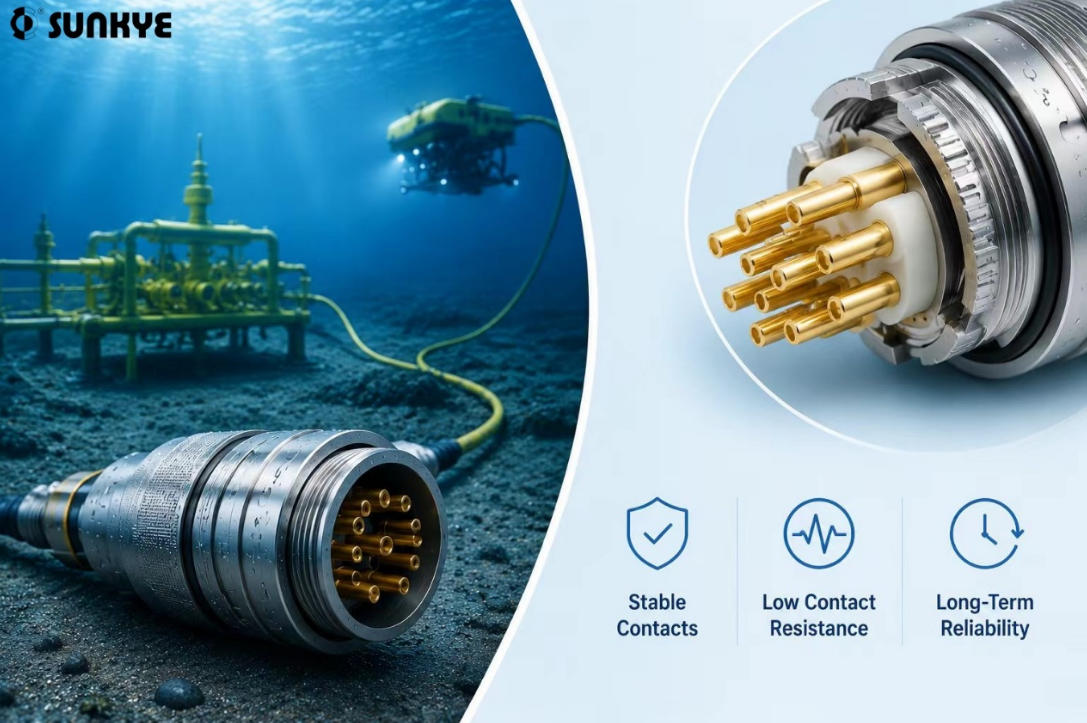
Sealing keeps seawater out, but long-term connector performance depends on stable electrical contact under pressure, vibration, and years of underwater operation.
When engineers evaluate subsea connectors, they often focus on pressure ratings, sealing performance, and operating depth. These factors are critical for surviving harsh underwater environments. However, another key factor determines whether a connector can truly perform over many years— contact stability.
Contact stability refers to the ability of electrical contacts to maintain consistent contact force, low contact resistance, and reliable signal or power transmission throughout the connector’s service life. Unlike surface applications, subsea connectors must operate under continuous pressure, vibration, temperature variations, and seawater exposure. Even when the external sealing system remains intact, internal contact performance can gradually change if the contact design is not optimized.
One common challenge is contact resistance increase. Over time, small changes at the contact interface may lead to higher electrical resistance, causing voltage loss, signal degradation, or additional heat generation. For high-reliability systems such as subsea monitoring equipment, offshore energy systems, and underwater communication devices, even small electrical changes can affect overall system performance.
Another challenge is micro-motion and fretting wear. During operation, vibration from pumps, subsea vehicles, or offshore structures can create tiny movements between contact surfaces. These repeated movements may damage plating layers, generate wear particles, and gradually reduce electrical stability.
Pressure cycling and thermal cycling also influence contact performance. During deployment, recovery, or long-term operation, repeated environmental changes can create mechanical stress inside the connector. Without proper structural design and material matching, these stresses may affect contact force retention and electrical reliability.
How SUNKYE Addresses Contact Stability Challenges?
At SUNKYE, contact stability is considered a critical factor in the design of high-reliability subsea interconnect solutions. Beyond achieving reliable sealing performance, SUNKYE focuses on maintaining consistent electrical performance throughout the connector’s service life.
To improve long-term contact reliability, SUNKYE applies several design approaches:
• Contact design optimization
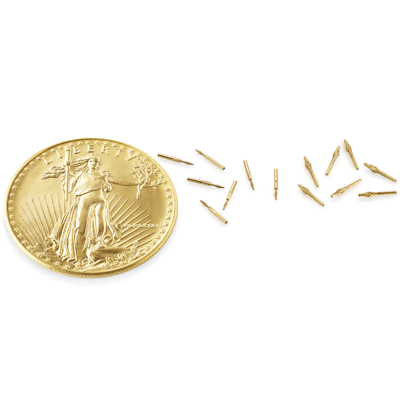
SUNKYE engineers contact structures to maintain stable contact force under mechanical stress, vibration, and long-term operation, helping minimize contact resistance variation over time.
• High-performance materials
Through optimized matching of contact alloys, insulator matrices (e.g., specialized polymers/PEEK, glass, or ceramics), and metallic housings, SUNKYE connectors prevent stress relaxation during extreme thermal and pressure cycling.
• Precision manufacturing and process control
Strict control of critical dimensions and assembly processes ensures consistent contact performance across different connector units.
• Application-oriented design capability
SUNKYE works with customers to develop customized subsea connectors and feedthrough solutions based on specific requirements, including pressure, temperature, electrical performance, and operational conditions.
Through continuous improvement in contact design, materials, and manufacturing processes, SUNKYE aims to deliver subsea interconnect solutions that provide reliable electrical performance throughout demanding underwater applications.

 English
  日本語
日本語  한국어
한국어  français
  Deutsch
  Español
  italiano
  русский
  Türkçe
  Svenska
  Nederland
  فارسی
فارسی فارسی
فارسی