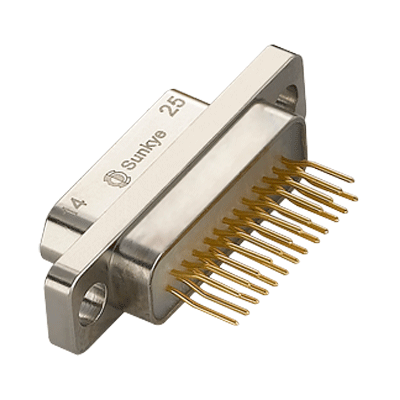
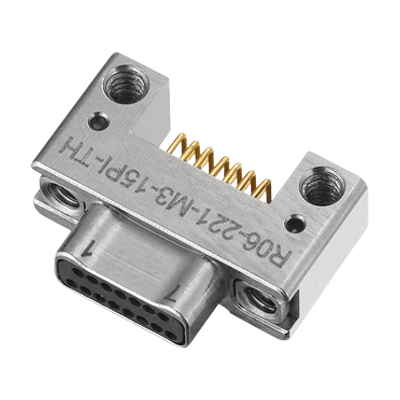
Sunkye’s PEEK feedthrough solutions with reliable process and materials make the performance meet and extend standards. 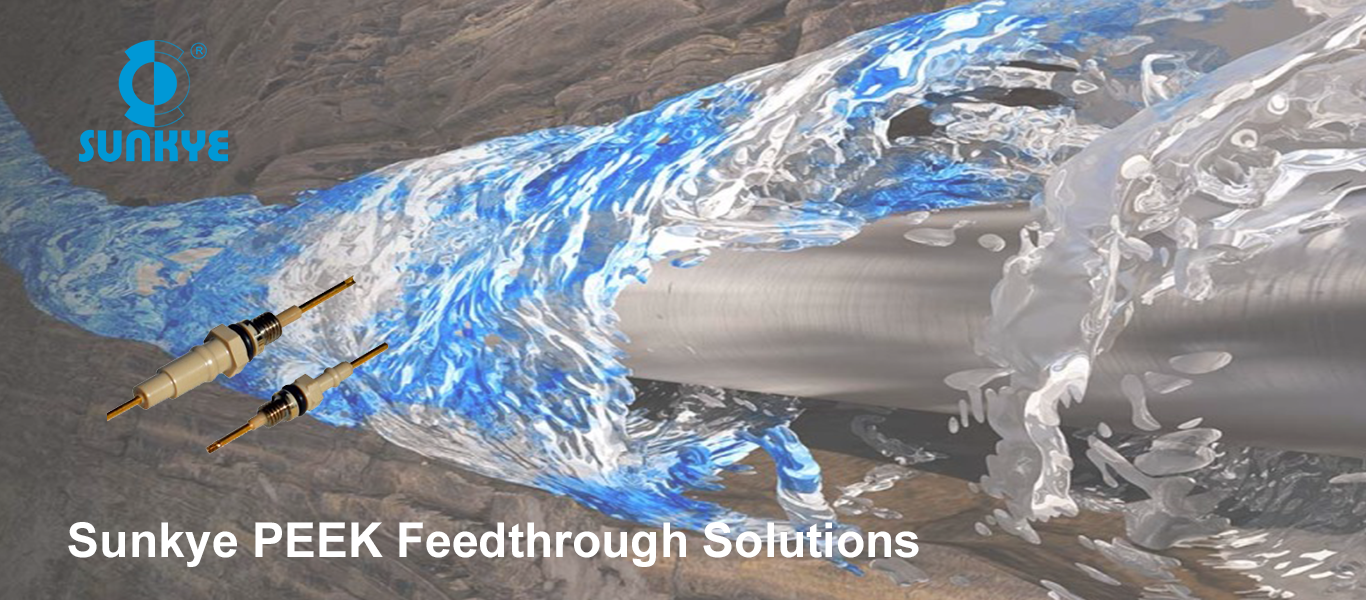
In downhole environments, connector performance is often evaluated based on maximum temperature and pressure ratings. However, in long term immersion applications such as MWD/LWD systems or permanently installed downhole tools the primary reliability challenge is not short term material resistance, but the long term stability of the sealing system under combined thermal, mechanical, and chemical loading.
PEEK feedthroughs are widely adopted in the industry due to their favorable balance of mechanical strength, chemical resistance, and manufacturability. Typical solutions are rated for temperatures up to 175–200°C and pressures up to 207 MPa (30,000 psi), with insulation resistance reaching ≥10 GΩ at 1000 VDC under ambient conditions. These characteristics make PEEK a suitable solution for many HPHT applications.
However, field experience and failure analysis consistently indicate that failures in PEEK feedthroughs rarely originate from bulk material degradation. Instead, the dominant failure mode is associated with long-term instability at the sealing interface.
Under sustained high temperature exposure, PEEK as a thermoplastic exhibits creep and stress relaxation. When sealing performance depends on the long term retention of compressive stress between PEEK and metallic components, this relaxation can gradually reduce sealing effectiveness. In addition, thermal expansion mismatch between polymer and metal introduces cyclic stresses during temperature fluctuations, which may promote microcrack formation or interfacial separation.
The significance of these mechanisms is strongly dependent on operating conditions. In moderate or short term applications, their impact may remain negligible. However, in long-duration deployments under elevated temperatures (e.g., >150°C, extended exposure beyond 500 hours), these effects can become a dominant factor in reliability.
Once a leakage path is initiated even at a microscopic level the failure mechanism transitions. Downhole fluids can penetrate into the connector interior, leading to insulation degradation, electrochemical corrosion of conductive elements, and increased contact resistance (typically designed ≤20 mΩ). This process is progressive and often difficult to detect in early stages.
From an engineering perspective, the degradation process can be broadly categorized into three stages:
· Stable stage – sealing integrity maintained, no measurable performance drift
· Degradation stage – micro-leakage, gradual insulation decline, signal instability or increased noise
· Failure stage – significant electrical degradation, intermittent or complete loss of signal, potential system-level failure
Importantly, early stage degradation is typically non catastrophic and may manifest as signal drift or intermittent communication issues, making detection and intervention challenging during operation.
The consequences of such failures extend beyond sealing integrity. Fluid ingress may lead to progressive insulation breakdown, unstable signal transmission (particularly critical in low level MWD/LWD signals), and localized heating due to increased contact resistance. In severe cases, this can result in loss of telemetry, tool malfunction, or costly retrieval operations.
From this perspective, the limitation of PEEK feedthroughs is not inherent to the material itself, but rather to how the sealing interface is designed, controlled, and manufactured. Long term reliability is therefore highly dependent on several key engineering factors:
· Interface geometry and stress distribution
· Control of assembly preload and tolerance stack up
· Surface finish and sealing contact quality
· Material consistency and resistance to long-term creep under specific loading conditions
Addressing these challenges requires a system level design approach, where material behavior, mechanical structure, and manufacturing processes are considered together rather than in isolation.
In practice, effective solutions typically involve optimizing the load path at the sealing interface, minimizing stress concentration, and improving long term stability of compressive forces. Tight control of material properties, processing conditions, and dimensional tolerances is also critical to ensure consistent performance over extended service periods.
In Sunkye’s implementation of PEEK-based feedthroughs, emphasis is placed on interface design optimization and process control to mitigate creep induced relaxation and maintain sealing integrity over time. By integrating material selection with structural design and manufacturing precision, the progression of leakage related degradation can be significantly reduced.
Therefore, while PEEK feedthroughs inherently involve interface related risks in long term immersion environments, these risks can be effectively managed through appropriate engineering design and process control. When properly implemented, they remain a viable and reliable solution within well-defined service boundaries, offering a balanced approach between performance, manufacturability, and cost.

 English
  日本語
日本語  한국어
한국어  français
  Deutsch
  Español
  italiano
  русский
  Türkçe
  Svenska
  Nederland
  فارسی
فارسی فارسی
فارسی