Engineering Trade-offs Between Alumina, Glass, Sapphire, and PEEK.
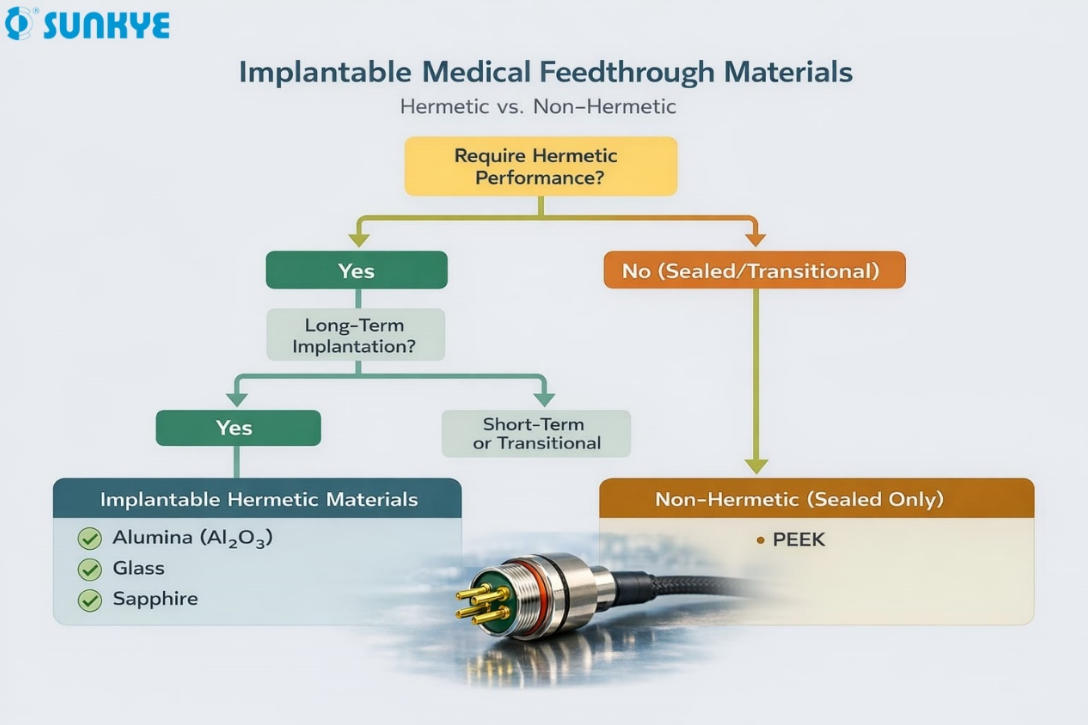
In implantable medical devices, electrical insulation materials are not only responsible for electrical isolation. They directly affect hermeticity, mechanical reliability, thermal stability, and long-term device lifetime. The material selection must be evaluated at the system level, not in isolation. From a feedthrough design perspective, insulation materials used in medical implants can be broadly classified into hermetic ceramics and glasses, and non-hermetic high-performance polymers. Understanding where each material fits—and where it does not—is essential for reliable implantable system design.
Alumina (Al₂O₃) is the most widely adopted ceramic insulation material in implantable hermetic feedthroughs. Its balanced dielectric strength, mechanical rigidity, and thermal stability make it suitable for ceramic-to-metal sealing structures. Alumina offers good thermal expansion compatibility with titanium housings commonly used in implantable cardiac and neurostimulation devices. As a result, alumina is frequently selected for feedthroughs that carry mixed power and signal lines and are expected to maintain hermetic performance over many years of implantation.
Glass insulation materials are commonly applied in glass-to-metal sealed feedthroughs, particularly where design flexibility is required. Compared to ceramic, glass allows greater freedom in pin layout and geometry, enabling high-density or customized feedthrough designs. When properly matched with conductor and housing materials, glass provides reliable hermetic sealing and stable electrical insulation, making it well suited for application-driven, custom implantable feedthroughs.
Sapphire, a single-crystal form of aluminum oxide, offers exceptional electrical insulation and long-term stability. Its crystalline structure provides excellent resistance to electrical breakdown, making sapphire suitable for specialized implantable applications involving high voltage or extreme electrical isolation requirements. However, higher cost and limited manufacturability mean sapphire is typically reserved for targeted use cases rather than general-purpose implantable feedthroughs.
In contrast, PEEK is a high-performance polymer widely used in medical implants for structural and insulating components. It offers excellent biocompatibility, mechanical toughness, and chemical resistance. However, PEEK is not a hermetic material and does not form a permanent barrier against moisture ingress. For this reason, PEEK is generally applied in non-hermetic insulation roles, such as structural supports, transitional interfaces, or sealed—but not hermetic—areas of implantable systems, rather than as the primary insulation material in hermetic feedthroughs.
There is no single insulation material that meets all implantable requirements. Electrical load, mechanical stress, thermal cycling, expected implant lifetime, and system architecture must all be considered together.
Material | Hermetic Capability | Typical Role in Implantable Systems | Key Advantages | Practical Limitations |
Alumina (Al₂O₃) | True hermetic | Primary insulation in Ceramic-to-metal feedthroughs | Balanced dielectric strength, high mechanical rigidity, good CTE match with titanium, proven long-term implant reliability. | Limited geometric flexibility compared to glass. |
Glass | True hermetic | Primary insulation in glass-to-metal feedthroughs, especially custom designs | High design flexibility, supports complex pin layouts and high-density configurations, reliable hermetic sealing. | Mechanical strength lower than ceramic, requires precise material matching. |
Sapphire | True hermetic | Specialized insulation for high-voltage or extreme isolation implant applications | Exceptional dielectric stability, single-crystal structure, excellent long-term electrical performance. | High cost, limited manufacturability, not suitable for general-purpose designs. |
PEEK | Non-hermetic
(sealed only) | Structural insulation transitional interfaces, non-hermetic zones in implantable systems. | Excellent biocompatibility, mechanical toughness, chemical resistance. | Not a permanent moisture barrier, unsuitable as primary hermetic insulation. |
At Sunkye, insulation material selection is driven by application requirements rather than material preference. By evaluating electrical, mechanical, and hermetic performance as an integrated system, Sunkye develops custom feedthrough solutions that place each insulation material in its appropriate role—supporting long-term reliability in critical implantable medical applications.

 English
  日本語
日本語  한국어
한국어  français
  Deutsch
  Español
  italiano
  русский
  Türkçe
  Svenska
  Nederland
  فارسی
فارسی فارسی
فارسی